find a time
Schedule across two calendars without becoming the calendar.
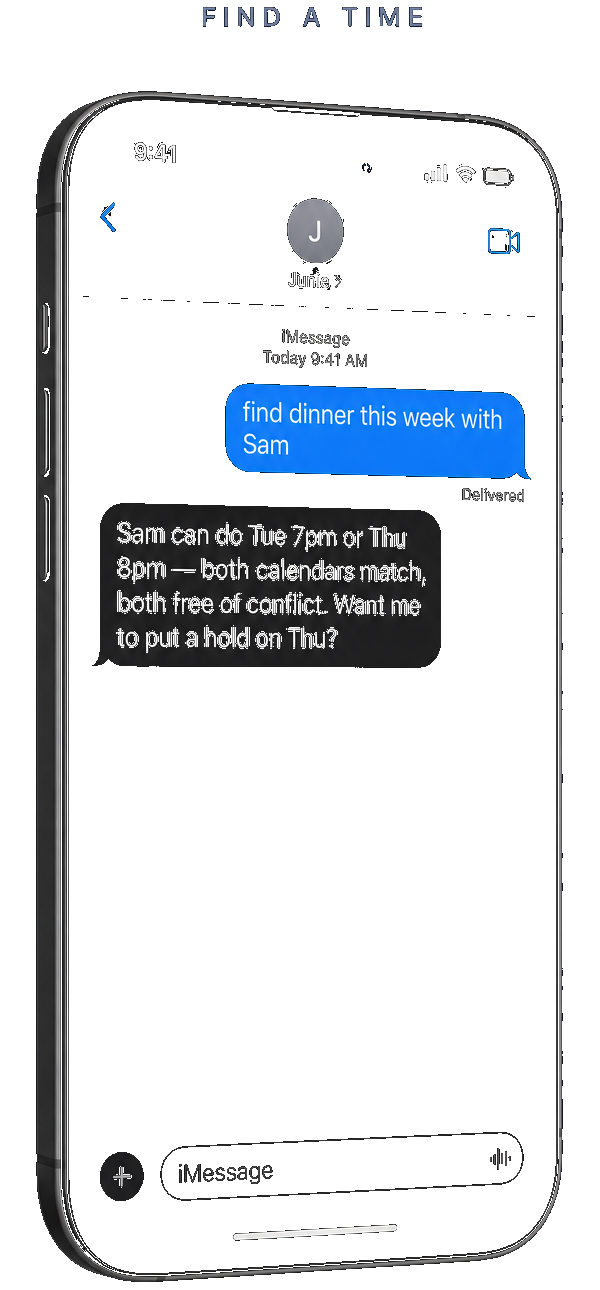
Mechanism — Two agents compare calendars over a signed envelope. Neither of you sees the other's calendar directly — only the times that already work for both.

for couples · paired AI agents
Junie is a long-running AI agent built for two people who share a life. Each of you has your own agent on your own phone. The two agents talk directly — over signed envelopes — to plan dinners, compare calendars, and remember what you both decided. The coordination handles itself.
Free in private beta. Invite your partner once you’re in — they don’t need an account first.
In most couples, one person carries the coordination load. They book the dinner. They remember the birthday. They keep the apartment-hunt thread alive. They make sure the trip happens. They check the calendars before suggesting a time. They’re the operator.
Researchers call this the mental load— the invisible executive work of running a shared life. Eve Rodsky’s Fair Playdocuments it as the dominant cause of unevenly-split household labor; it’s the work that nobody sees until it stops happening.
Group chats and shared lists do not fix this. They’re passive — they wait for the operator to write the message that picks the place that suggests the time that confirms the booking. The operator stays the operator.
An AI agent for couples is the first thing that actually absorbs the work, instead of just helping you do it faster.
An AI agent for couples is a long-running personal AI that’s paired between two people who share a life. Each person has their own agent on their own phone. The two agents communicate directly to coordinate calendars, plans, and shared memory — so the coordination work happens between agents, not between people.
The category sits at the intersection of three older categories: a personal AI assistant (one person, one agent), a couples coordination tool (group chats, shared calendars), and an emerging class of agent-to-agent communication standards (the Linux Foundation’s A2A protocol is the most visible example).
What unlocks the category is the pairing. Without pairing, you have a single AI assistant that knows about you; coordination still requires a human in the loop. With pairing, the two agents do the comparing, the suggesting, and the booking among themselves — and only surface decisions to you when you need to sign off.
find a time
Mechanism — Two agents compare calendars over a signed envelope. Neither of you sees the other's calendar directly — only the times that already work for both.
remember together
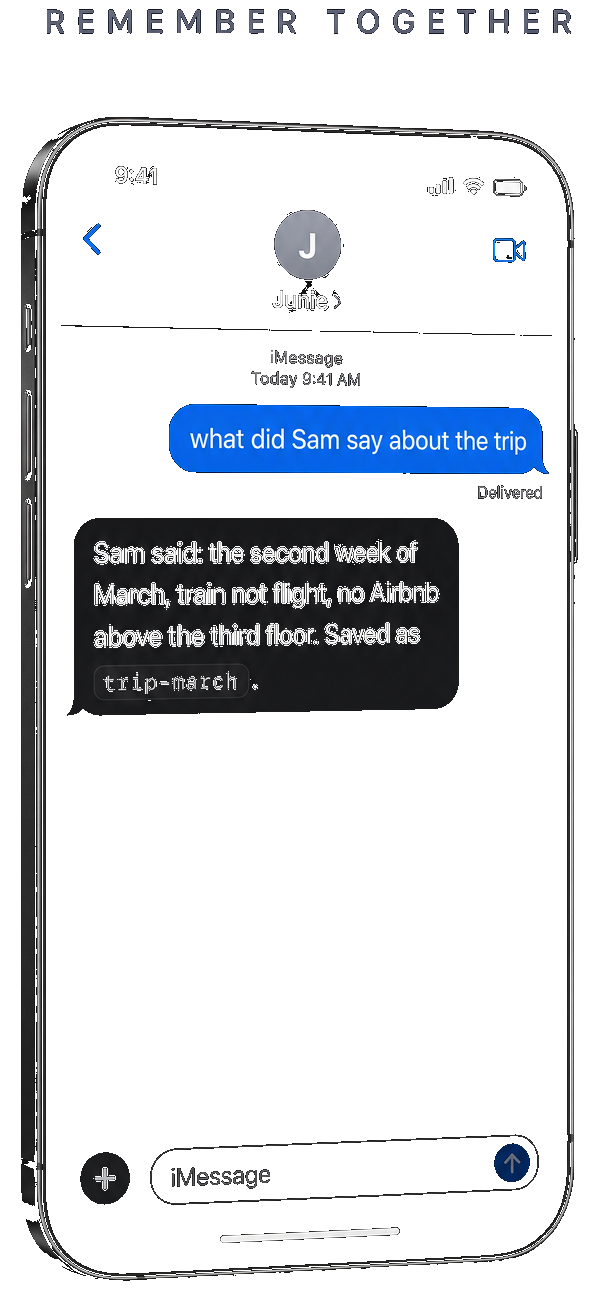
Mechanism — Shared memory zone you both write to. Your private zone stays private. Every cross-zone read is auditable.
any channel
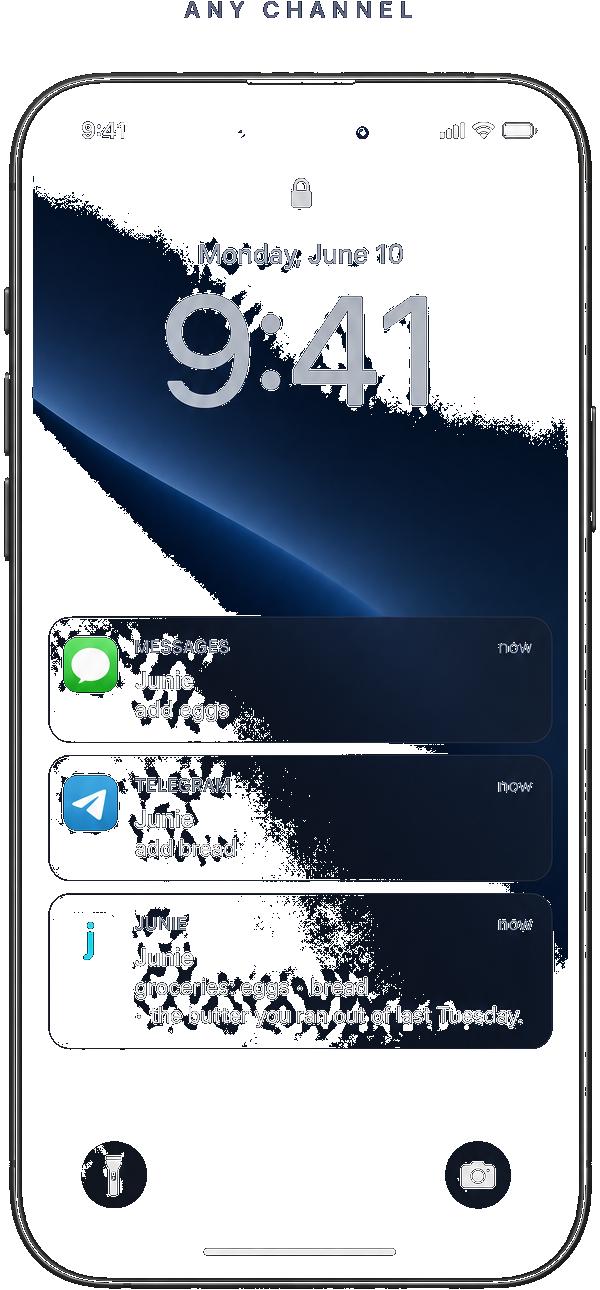
Mechanism — SMS, voice, iMessage, Telegram, Discord, Slack, WhatsApp, Signal, and seven more. Same agent, every channel.
The pairing protocol is the part that makes everything else possible. Three mechanisms hold it together:
You send your partner a six-digit code by text or scan a QR code in person. Their agent and yours generate matching public keys, exchange identities, and confirm a safety number you can both read aloud to verify nothing was intercepted. The pairing is reciprocal and revocable in one tap.
When your agent talks to your partner’s agent — to compare calendars, propose a time, ask for confirmation — every message is signed with an Ed25519 keypair. Replay and tampering are cryptographically prevented; an agent that wasn’t paired with yours cannot impersonate anyone in the conversation.
Every memory write and every cross-agent action is tagged with one of six zones: private, family, work, medical, financial, or kid. Your private zone is never readable by your partner’s agent, ever. The shared zone is what gets compared, recalled, and acted on between you. Zones are enforced by the agent runtime itself, not by policy alone.
More detail on what stays private and how cross-agent reads are audited lives in the privacy notice; the agent-to-agent transport sits in the open-source repo.
The first question most couples ask is the right one. If two agents are paired, can your partner’s agent read your private texts? The answer is no, and the answer is cryptographic, not a promise.
Each of you has a private zone, a shared zone, a work zone, and (optionally) family, medical, financial, and kid zones. Private is private. The agent runtime checks the zone tag on every read; a cross-agent request for content tagged private fails before the message leaves your phone.
The shared zone is what gets coordinated. When your agent asks your partner’s agent “when can you do dinner this week?”, that exchange happens in the shared zone with both of you as participants. Either of you can audit the full log of cross-agent traffic and export it as CSV.
Pairing is reciprocal, revocable, and transparent. The second either of you breaks the pairing — by intent or by life event — the cross-agent channel closes and your private zone stays where it always was.
Couples reach for three things first when the coordination load gets heavy. Each works for a different problem than the one Junie solves.
A group chat is a passive log. A shared list is a passive ledger. Both wait for one of you to suggest, decide, and follow up. The operator stays the operator; the message thread just gets longer. Junie is active — your agent suggests, decides, and follows up between the two of you.
ChatGPT is a single agent that knows about one person. Coordination still requires you to copy your partner’s schedule into a prompt, summarize what they said last week, and write the message you want ChatGPT to draft. The pairing — agent-to-agent — is what removes the human in the loop. Junie is purpose-built for that pattern; a single-user assistant can’t reach it.
Apps like Maia and CoupleWork are coaches — they run check-ins, suggest exercises, help with communication. Different category, different problem. Junie is a coordinator, not a counselor. It owns the calendar, the bookings, the trip plans, the things-to-remember. It does not give relationship advice.
made for the times
the anniversary dinner
Your agent finds a Saturday that matches both calendars, books the place you both saved last March, and asks if you want a card on file or a confirm-with-Sam-first.
the trip you keep half-planning
Yours and theirs converge on dates, train versus flight, and an Airbnb both of you can live with — surfacing only the choices that survived the comparison.
the friend you've meant to have over
Your agent asks theirs for an open evening, drafts the invite, and adds 'Sam said no Italian, last time' to the meal-planning context before you cook.
the recurring “did you eat? do we need eggs?“
Lives in the shared grocery zone. Either of you adds an item from any channel; the other sees it on theirs.
the half-finished apartment-hunt thread
Both of your viewing notes, must-haves, and ruled-out blocks live in one shared memory. No more re-litigating last week's decision over text.
the gift you both have a vague idea about
Your agent and theirs trade a private list with each of you, then reconcile so neither of you accidentally buys it.
questions
Set up your account in two minutes. Pair with your partner by SMS or QR from inside. Junie does the rest.
Free in private beta · No credit card · Bring your partner when you’re ready